Monday, April 19, 2010

Aah, Dir. (あぁぁ、ディル。)

(Admittedly, their name is romanized no matter where they are. I just wanted to make things easier pronunciation-wise.)

Well, it had to come out eventually.

Yes, despite the fact that I try to present myself as somewhat mainstream...

Oh dear. Forgive me; that sounds far more snot-nosed indie-kid than I intended. Let me rephrase.

Though I do enjoy music that appeals to a wide range of audiences, my true love is for the harder, less universal stuff. Hard rock, metal, grunge; all that wonderfulness.

Most importantly, however, I love Dir en grey.

Now, I would be to ashamed to show my face if I had to use Wikipedia, so today, despite the fact that it may be sub-par, the information you're getting is coming straight from my head. Because, hey, I have pride issues. Deal with it.

Formed in 1997 from the ashes of the Indies group La Sadies, Dir en grey is a hard rock band consisting of 京 (Kyō) on vocals, 薫 (Kaoru) on guitar, Die on guitar, Toshiya on Bass, and Shinya on drums. 薫 is, to everyone's agreement, the band leader; according to rumor, this is because he is the scariest of the lot and not to be messed with. 京 writes all of the lyrics (which I will discuss later), and while they used to split song-writing up between them (one or two people doing each song), more recently the songs have all been collaborative efforts, attributed to the band as a whole instead of one member.

In their early days, they were produced by Yoshiki, charismatic and never aging (seriously, look at some picture, man hasn't aged in fifteen years) drummer from the Visual Kei legend X-JAPAN, Dir en grey was very V-Kei themselves, focusing very much on their look and producing, for lack of a better word, "popular" music. Again, punch the elitist indie kid, I know, but... oh, drat. It's just that they usesd to be V-Kei and not hard rock, is that better? There's a reason they no longer appear on Music Station, all right?

Perhaps it's best if I just show you.

This is 予感, taken from their first full-length album, GAUZE:


(Side Note- So what do you think of my new music-sharing-thingy-jobby? Better than youtube? Worse? See that comment button? Yea. You know what to do.)

Sounds poppy, yes? This song was performed on Music Station, though cut short for reasons I can't fathom. Admittedly, this is not to say that the entirety of GAUZE is poppy; far from it. It's not even a bad album. It simply conforms to what people think of as V-Kei, and it doesn't fully display their creative abilities. Which is a damn shame considering the following:

(1) 京 writes ridiculously difficult lyrics. For funsies. He uses archaic kanji, strange kanji, weird vocabulary, anything he can get away with. I was once told by a 神戸女子大学 (Kobe Women's College) student that Japanese people don't like Dir en grey because they can't understand them. Come on, that's pretty cool.
(2) The entire band is massively talented. Just... massively. I'm horrible at music theory so I'm going to fail at explaining, but suffice it to say that neither guitar is lead because both are excellent, Toshiya is a good bass player who gets solos instead of a throwaway member, and Shinya can play the drums faster than humanly thought possible.
(3) These men have the capability to produce, on the one hand, horribly rough, screamy songs, and on the other, beautiful, tear-jerking melodies. And everything in between.

I admit, I'm a bit of a fangirl. I have waited for these guys in a 27 hour line before (and got in the pit with one of Toshiya's picks to take home to show for it), if that's any indication.

But I'm sure you're sick of my prattling on by now. More music!

"ain't afraid to die" is one of their tear-jerking songs, which I spent a while translating for a class last year. Very sad. Also, interestingly enough, only played at Japanese lives; I've been to two lives in America and one in Japan, and it was only performed a the latter. Japan, apparently, loves this song (as do I), whereas America hates it. Although considering the fact that I heard girls in that 27-hour line discussing how they could no longer listen to GAUZE, I suppose they're making the right call here.

(Side Note- What the hell, America.)

It was never put on an album, only released as a single. I'm not quite sure why.


Yes, it's long. It's also worth it. Many of the people I could see at the Osaka-jo live were crying throughout. It's a very sad song. (I would post my translations, but I did spend copious amounts of time on it, and am paranoid about the translation thieves, so... if you'd like to know what the song is about, feel free to ask me.)

Just a few more, I promise. Let it never be said that I didn't give you lot a good smattering of music to contend with!

かすみ is from VULGAR, their fourth full-length album put out in 2003. Another one I spent days translating, which I think is also very pretty. Definitely more haunting than tear-jerking, though.


Finally, GLASS SKIN. I'm posting here the single version, because for some reason, 京 decided that the album version would be in English. Yes, Dir en grey is a band that makes sure you get your money's worth when you purchase singles. No simple album previews here, my friends. I find it particularly intriguing that they're the only band I know with a tendency to re-write lyrics between single and album. Regardless, GLASS SKIN is likely the prettiest song out of the recent bunch.


...oops, I lied. INCONVENIENT IDEAL is arguably my favorite Dir en grey song (if I can have a favorite), and I simply couldn't not post it for your listening pleasure. Very good song; it's the last track on their latest full-length album, UROBOROS, which was released while I was studying in Kyoto.


Well then, how was your foray into the wild, wide world of Dir en grey? (Points to me for alliteration; yes I noticed.) Not as bad as you expected, eh? Admittedly, I did supply songs that were on the lighter end of things; as I always say, you can't get people interested by blasting their eardrums off. (Though I suppose I did hear 脈 first...) Thus, a selection of palatable Dir en grey that the whole family can enjoy... provided, of course, you don't translate the lyrics.

This is Edo, signing off still wishing that Dir had hired her to do their lyric translations. (Because goodness, whoever they actually hired clearly has the English skills of a fruit bat...)

Sunday, April 18, 2010

Gettin' Academic. (学究的になってる。)

Well, I did say I'd dabble in a few academic things, didn't I? I am, after all, still an academic myself, and will always be one at heart (despite the fact that the potential for tenure at a decent school nowadays has somewhat knocked me from my professorial track.)

Ergo, you get academia. Expand your minds, kids. It's good for you.

And today isn't just any old academia. Oh, no. Today, my friends, we delve into 和歌 (waka), or the classical form of Japanese poetry built upon the syllable format 5-7-5-7-7. You simply don't get much more academic than that. (Ok, sure, we could get into 漢文 and Confucianism, I suppose, but you need to quit being so ornery.)

We will, in fact, be discussing my favorite 和歌, which is, coincidentally (or not so, based on what you know of me), one of the more confusing and difficult to interpret 和歌 that modern scholars know of. Oh ho ho.

As you may guess from the labels below, this 和歌 is from the 伊勢物語 (Ise Monogatari), a collection of Heian period tales bound together in some semblance of plot (but not really.) I admit the only part I remember in detail is when Narihira sleeps with that shrine maiden... (And, of course, the part we read in Classical, wherein the travelers re-hydrated their dried rice with their tears. You can't get any more Heian than THAT, my friends.)

The basic back story to this 和歌, as taken from a handout we received in class (thank Helen McCullough) is as follows:

Once when the ex-empress was living in the eastern Fifth Ward, a certain lady occupied the western wing of her house. Quite without intending it, a man fell deeply in love with the lady and began to visit her; but around the Tenth of the First Month she moved away without a word, and though he learned where she ad gone, it was not a place where ordinary people could come and go. [Edo's note: This means that she went to a convent. A Buddhist one, mind you, but she was a nun nevertheless.] He could do nothing but brood over the wretchedness of life. When the plum blossoms were at their height in the next First Month [Edo's note again: Remember kids, lunar calendar!], poignant memories of the year before drew him back to her old apartments. He stared at the flowers from every conceivable standing and sitting position, but it was quite hopeless to try to recapture the past. Bursting into tears, he flung himself on the floor of the bare room and lay there until the moon sank low in the sky. As he thought of the year before, he composed this poem:

月やあらぬ
春や昔の
春ならぬ
わがみひとつは
もとの身にして

He went home at dawn still weeping.


Tragic and beautiful, yes? That, my friends, is Heian literature. The men sob, the women are bitchy, and everyone composes poetry--for seducing, for lamenting, and sometimes just for shits and giggles.

However, while could discuss the merits and flaws of Heian literature for hours (including how Genji is, in fact, a total creeper), what we're here for today is that 和歌. While those of you who don't read Classical Japanese may not notice, the poem is... how shall we say... vague. It's almost ungrammatical. Even other Heian era poets called him out on this one, like Ki no Tsurayuki: "The poetry of Ariwara no Narihira tries to express too much content in too few words. It resembles a faded flower with a lingering fragrance." Ooh, Heian snap.

While I may disagree, it is very difficult to interpret and translate. A number of people have tackled it, and most of them have just plain failed; I'm looking at you, H. H. Honda. The best translation, in my opinion (and that of my classical professor, Peter Flueckiger), is Helen McCullough's:

Is this not the moon?
And is this not the springtime,
The springtime of old?
Only this body of mine
the same as before...

Notice TWO things:
(1) She maintained the trailing ending. The original poem does not end grammatically, it trails off. McCullough is the only one (at least in the list of translations I have) who maintains this sense of unfinished-ness.
(2) She freaking maintained the 和歌 format. 5-7-5-7-7. Count 'em. Normally, I frown upon this, as I find it prosaic and stupid, considering the fact that English is not broken up as neatly as Japanese is and does NOT work well with this sort of poetry. Translators wind up butchering the original to make the English nice and neat. However, when the translation is that good AND maintains the format? I am floored.

I was going to offer you my own translation, but frankly... I can't top that. And after seeing it, all of my translations will be somewhat influenced by it. We did translate in class before reading the English versions, but I have no idea what I came up with all those weeks ago.

Well, dear readers, how did you enjoy your very atypical cultural lesson? Never thought you'd learn about Heian literature from this blog, did you? Oh, I am simply full of surprises, ah ha ha.

This is Edo, signing off while considering her odds of being a decent Heian aristocrat. (Not good.)

Saturday, April 17, 2010

It's not so bad after all. (思ったよりいいかな。)

Just a quick little life update before we get down to business.

I submitted my thesis this afternoon, which is an accomplishment. Point one. I also, however, found at least two typos on it after it had been printed and bound... why is it that we never see our mistakes until there's absolutely NOTHING we can do about them? ...I think that speaks about life in general, really. Damn.

Regardless. I have also discovered that, despite my MAD stressing over the fact that I currently do not have a job, I am a little relieved to discover that, hey, what do you know. I have a life plan. And guess what? Apparently, that's not exactly common among my 20-something age group.

Whodathunk?

Despite my being rejected from one job and alternate-listed for another, I know exactly (a) where I want to go and (b) how to get there (theoretically.) I am making connections whenever I can and scrounging around for as much information as can fit into my college-fried, stressed-out brain. My goals are not unrealistic, and I have at least a rough plan of what I should be doing five, ten years in the future.

And, most importantly, I KNOW this because I've ASKED people.

Why doesn't anyone think about that anymore? Just ask. What can it hurt? The worst anyone can ever say is "no." (Ok, ok, technically they can also say "BEGONE FOUL BEAST" and file a restraining order while flinging various holy symbols in your general direction, but...) And for goodness sake, don't you think the people actually doing it are better with the advice than just the people who want to do it?

Sometimes, I freak out, and then I realize. I'm grounded. (You are a good influence on me, Melon.) And heavens to murgatory. I'd rather be grounded than just lucky (although admittedly I'd LOVE to be lucky too. Damn my fate.)

Er. I guess that wasn't as quick as I had originally intended. Oh, well. Such is life.

ANYWAY. Back to your regularly scheduled Japan blog. (I wonder what it means that "Japan blog" is almost a category in and of itself lately...)

Today, we will be talking a little bit about スガシカオ, or Suga Shikao for all you English speakers out there. (I guess I do write my blog in your language after all, I shouldn't be surprised that you read it.)

According our dear friend, the wondrous and many splendored (Firefox thinks that's not a word, but I disagree heartily) Wikipedia:

Shikao Suga (スガ シカオ, Suga Shikao, born July 28, 1966) is a Japanese musician and singer-songwriter from Tokyo. Though he uses katakana for his recording name, the kanji for his name are 菅 止戈男, but the romanization is the same. Suga is his family name and Shikao is his given name.

After graduating from Tokyo Keizai University, he worked as a "salaryman" for four years in the advertisement industry. Debuting with a major label EP album release in 1997, his J-Pop music has jazz, funk and soul influence, coupled with beautiful and moving lyrics.


...I did not know he was 43. Hooo. What is it with me and these old guys? Does my generation simply not produce quality music like those of the past have? (The answer: no.)

But yes, quite an interesting past for a musician, no? I suppose luck hits you no matter where you are, even if your soul is being gradually chipped away by your mind-numbing corporate drone job...

But I digress.

I only discovered スガシカオ by accident, as is my wont with bands I then grow to like/love/obsess over (Dir en grey, anyone?). Back in 2007, when I was a wee ickle underclassman spending my summer in Hokkaido, he had just come out with this single:


which was popular enough to have the video playing in the Karaoke venue where I was spending the afternoon one day. Really, it was very accidental, considering the fact that usually, such venues are so loud with music blaring over the speakers that you can't hear a word of what's being sung in the actual videos they have playing everywhere you look.

Anyway, I was intrigued. I wrote down his name from the video, was told the next day by a guy I was chasing at the time that he was a solo artist, and not a band as I'd thought (hey, I see all katakana, I get confused), and eventually found my way to his music through the glorious internet after I'd returned home.

(Side note- Who ARE these random white girls that pop up so often in Japanese music videos? Where do they come from? ...how do I get their job?)

I remain dubious as to his style, regardless of Wikipedia's inclination to label him "funk" (what IS funk anyway?), and really like him mostly due to his intriguing vocal style.

Remember, a few days ago, how I mentioned something about singing so quickly that it seemed you were bound to trip over yourself? Yea, like that. It's also partially breaking words up in different places than you normally would... but I'm horrible at explaining it, because I really don't know what it is myself... all I know is that I like it. Perhaps it would be best with a demonstration:


As soon as he goes into the verse. See? Not that beginning part. No, no, the middle. See? Yea, that's it.

I'm sure you see...er, hear exactly what I mean.

Regardless, this is the reason I like スガシカオ. You, I'm sure, may like him for an entirely different reason, as is your right. I was simply being a good blogger. And then you had to be all judgmental. Sheesh.

(And does he look to be in his 40s to you? No, I didn't think so. How do you say... oh yes, "homina homina.")

This is Edo, signing off while wondering if スガシカオ would harmonize well with Kimutaku...

Thursday, April 15, 2010

A little bit at a time. (一度に少しずつ。)

I have, in earlier posts, mentioned my love of SMAP. Or, more importantly, my love of Kimutaku which has sort of encompassed SMAP as a whole.

Well. I thought I'd gradually draw you all in, so as not to frighten you off.

So, today. Installment one of "getting to know SMAP."

... but, uh. I mean this totally... flippantly, shall we say. I do not have the patience to actually sit down and write you a history or anything.

No, this is mostly going to be me showing you videos, and you going "ooo, aah" appreciatively at appropriate moments. This is a blog, not a public service announcement. You've got to learn to do things on your own, you know!

Well, according to good ol' Wikipedia:

SMAP is a Japanese idol group formed by Johnny & Associates. While originally consisting of six members, the current group members are Masahiro Nakai, Takuya Kimura, Tsuyoshi Kusanagi, Goro Inagaki and Shingo Katori. The group's name is an acronym standing for Sports Music Assemble People.

SMAP debuted their first CD in 1991 and has since released over forty singles and twenty albums. Approximately half the singles and a third of the albums reached the top of the Japanese Oricon music charts. In recent times, the interval between the band's single CD releases has become longer, and are now released approximately once a year.

The members of SMAP have also pursued careers outside of music, including involvement in television variety shows, dramas, commercials, and movies, making them one of the most popular Johnny's groups. Largely due to their popularity, Johnny & Associates became the most successful agency in Japan, with earnings of almost three billion Japanese yen in 1995.[1] Their fanbase consists primarily of Japanese women. SMAP is often considered to have gone past the so called "Idol Group" status, and have become the "Top Group" in Japan. SMAP is also well known in many other Asian countries.


Can you tell I'm an academic?

Yea, they're pretty big. Also, Kimutaku (the nickname given to Kimura Takuya that everyone, even people who don't lust after him, uses) is credited as being the catalyst that launched the modern wave of Japanese males who go to salons, style their hair, and generally take care of their appearances. This especially stands out in comparison to, say, American males, who tend to find such activities as indicators of homosexuality. Because, yea, that follows.

But I won't get into gender and sexuality today, kids.

Instead, I'm sure I speak for many when I say, "thank you, Kimutaku." Also, "homina homina." Or whatever it is you kids say nowadays.

Anyway, the important thing is that SMAP does a variety show every Monday night (late, which is an indicator of its potential for raunchiness) called SMAPxSMAP, which always involves a bit where they cook for guests, sing with other guests, and a number of sketches or games in between (which may or may not involve cross-dressing.) A very satisfying show, I must say... although the cooking bits always get me salivating. I assume they weren't so skilled ten years ago, but now, they produce five-star restaurant quality meals. It's mind-blowing.

ANYWAY.

The singing, which always takes place at the end, can be good or bad, depending on their chemistry with whoever the singing guest is.


With Superfly, for instance. I love them both, but SMAP doesn't really get into it until about half-way through. I'm thinking it may have been a bad day, because the interview afterward seemed amiable enough.

(Side note, but I love how Japanese music shows always have the lyrics on the bottom of the screen. Very helpful. It also puts me in a translating kind of mood... Not that you're interested, I'm sure.)

(Another side note is that Nakai, the one typically wearing a hat, cannot sing. This is not debatable. He simply can't. He may have been able to before his voice became that hoarse smoker's rasp that he's got now, but, as it is... just no. Don't question it, just let it go.)


And yet, for some reason, they seem to get along very well with the Black Eyed Peas. Who knew. (Although Kimutaku does complain that Fergie abuses him; notice her enthusiastic moshing at the end. DO NOT LIKE.)


And then sometimes, they just go at it alone, which has its benefits. After all, they are a boy band. If they're not using their own songs, their choreography gets all mucked up.

(I'm a little biased, I admit. I think Kimutaku looks particularly nice in this video. I love the half pony-tail look. Also, I, uh... kind of love this song. DON'T JUDGE ME.)

ANYWAY.

I hope you enjoyed today's installment of "Getting to know SMAP," and be sure to tune in again next time, when we will discuss how exactly men in their mid to late 30's can get away with this kind of malarkey.

This is Edo, signing off completely unashamed of her passion for Kimutaku.

Monday, April 12, 2010

The eternal question. (永遠の質問。)

I wonder if that translates properly. Hm.

ALT or 英会話?

Assistant Language Teacher or English Conversation School, for those of you not as desperately immersed within the culture as I.

ALT is what the JET programme would employ you as; basically, you work for the public school system, "assisting" the Japanese national English teacher. It's very likely that you'll simply wind up being a human tape recorder, but at the same time, you are, more or less, a part of the school, and interacting with people outside of your "customers." (How willing your fellow teachers are to accept a gaijin in their midst, however....) You're also, supposedly, better linked with the community in general; after all, you're a public school teacher entrusted with the welfare of the chillins of the nation, not just some schmuck trying to sell English abilities to the highest bidder, so people are far more inclined to, you know, speak with you. And, say, invite you to dinner. Give you some nice fruit. Things along those lines.

It sounds lovely on paper. Unfortunately, it tends to be the less financially appealing of the two; hooray for public schools. (Unless, of course, you're with JET. Their pay grade is OBSCENE. OBSCENE, I tell you. Which makes being an alternate hurt all the worse.... sigh.)

英会話 has a somewhat unsavory reputation, as most of us who hear it immediately think of the NOVA scandal (to put it mildly) and other horror stories of gaijin English sweat shops. Not to mention improper visa sponsorship, oh my. However, they aren't all bad, especially, as I've been lead to believe, if you avoid the "Big 4" (NOVA, Aeon, Geos and... Blitzen? I think.) The pay is, of course, better than you would receive as an ALT; it's a private company. However, you're a salesman, first and foremost, and often wind up having to treat your students as customers, especially with Aeon, apparently. ("Hey, you know, you should really consider buying our textbooks. And signing up for another year! Hell, make it five! By the way, if I you don't bite, they dock my pay for three months and force me to scrub the bathrooms with my toothbrush, so please, think of the starving whitey!") A number of places will provide you with an apartment at varying expenses, something which most independent ALT contractors simply can't do due to monetary concerns.

(Neither of these are full descriptions, obviously, nor are they exactly unbiased. Just a little disclaimer there.)

Pros and cons both ways is the conclusion I come to, and I must admit to being swayed by my capitalist desire for, you guessed it, cold, hard cash. Not to mention the fact that 英会話 schools tend to be more conveniently located, leading to (theoretically) an easier path to future employment. But then again, you are alone, and is money enough to keep your psyche from cracking under the sheer weight of your lonely gaijin existence?

(Have you guessed that I'm dubious of 英会話 schools that offer friendly support staff? Yea, right. You're their English monkey, they're willing to support you only as far as they can stretch the banana. Metaphorically speaking, of course. Bananas are expensive in Japan.)

I must note, that latter point really is important. If it's any indication, despite my desire for all that cash and future mobility, I remain dubious about 英会話 in general and sorely tempted to continue searching out a reputable ALT position. Even if it means eating a little less...

As always, I am eager to hear comments from you, my loyal readers. Admittedly, in this case, I'm also open to any advice, experience, or horror stories you'd care to share. Really. Hit that comment button. It beckons you.

If only game companies were more willing to interview over Skype. Oh, sigh.

This is Edo, signing off as her stomach churns over her uncertain future.

Saturday, April 10, 2010

Again huh... (またか。。。)

Once again, I have learned that rejection is truly the be-all-end-all of depression.

At least, from this perspective. I must admit, I am a little biased. But not having a job is a bit of a downer, I must say.

However, I do have advice for those of you on the Japan front:

Apartments do not necessarily require key money.

WHO KNEW?

While cruising through the At Home website, I've discovered that there are quite a few apartments that require no up front money aside from your rent.

And these are not necessarily sketchy establishments! (Not judging from the pictures they post, anyway... although, you know what they say, on the internet...)

Regardless, this is a pretty big deal. Without key money/finder's fees/pay us because we said so/whatever, it seems that moving about in Japan is not really as bad as it seems.

Then again, I could be wearing my rose-coloured glasses (highly unlikely, considering how my day has gone) and misreading things entirely, but...

Come on. It looks pretty nice from where I sit, and considering where I sit, it must look pretty darn nice indeed.

So. Just something to keep in mind, all you Japan-hopefuls. You can find yourself a place to live on a fairly modest budget, so don't give up hope yet.

Because goodness gracious me, if we give up hope, all we have left is our belly lint. And no one ever got anywhere relying on belly lint, let me tell you.

This is Edo, signing off and really, really trying to make the best of her situation.

Thursday, April 8, 2010

Somehow... it's become a bit dull. (何か。。。つまらなくなっちゃった)

I do apologize, oh loyal readers. I really do mean to supply you with more interesting and engaging content, but... well, sometimes the ol' noggin runs empty. Or at least, it runs slowly enough that the things it produces are deemed "worthless" and summarily dismissed before they have he chance to reach you, my adoring public.

I promise, I do try to maintain that recent, March fever-pitch, but, well, sometimes... life just isn't all that interesting.

HOWEVER.

There is one interesting thing I have to share with you all.


That's right.

I got my hot little hands on BUCK-TICK's new single, 独壇場Beauty. FINALLY.

I mean, seriously, it came out the 24th, I was getting a little desperate over here.

Admittedly, as I had already heard the eponymous single itself, it wasn't much of a shock, but at the same time... watching something on youtube and having it in your iPod to carry with you always are two entirely separate things.

Also, there was that other song...


Voo Doo is, alas, not nearly as pleasing, in my opinion, as 独壇場Beauty itself, but still worth a listen. There's also a live version of memento mori's 天使は誰だ filling out the single, which I am... ambivalent about. I enjoy BUCK-TICK live, and, quite honestly, think they have the potential to be BETTER live than recorded (that Kobe show was AMAZING), but it seems they picked rather sub-par recording to place on the disc. Or maybe something about the acoustics of a stadium (I think it's Zepp Tokyo) being recorded onto a disc robs Atsushi's voice of it's live magic...

Who knows.

Regardless, in my opinion, you'd be getting your money's worth for 独壇場Beauty alone. A definite "thumbs up" in my books.

Now, if only I had the ¥18,900 to blow on the figurine set...


That's right. Figurine set. I only wish I could scrounge up a larger picture to better convey the magic of tiny, tiny BUCK-TICK.

Just think, though. For 200 bucks? They must be some pretty magical figurines. The words "fully pose-able" come to mind...

This is Edo, signing off, woefully lacking her very own mini-BUCK-TICK...

Tuesday, April 6, 2010

Don't worry, be happy. (心配しないで、幸せになれ。)

So I guess I've resigned myself to an every-other-day schedule.

Oh well, there are worse things.

In any event, I thought I'd share with you all a very cheerful, uplifting song today.

Because, sometimes, isn't that exactly what we need?

ウルフルズ (or Ulfuls, for those of you who've seen them romanized), once again according to my beloved Wikipedia, "is a Japanese rock band from Osaka. The band name Ulfuls is derived from a misreading of the word "soulful," found on the cover of one of the band members' favorite records." And when we say from Osaka, we mean it; these guys are awesome because instead of singing in mostly 標準語, or standard Japanese, they use their native 関西弁 (Kansai-dialect) quite liberally. And, of course, being a lover of all things Kansai, naturally they get a nod from me.

Apparently, they stopped touring in 2009 though... sad news. Oh well, they can't all go on forever!

Anyway, the song I wanted to share with you all today is, as mentioned above, very uplifting. The title itself, 「ええねん」 is a testament to that. How to translate... aaah. In 標準語、it would either be 「いいんだ」 or 「いいんだよ」, which would roughly translate to "it's good"/"it's fine." Unfortunately, the English doesn't quite get it across... Especially the Kansai version. Because, darn it, Kansai is deep stuff.

The message of the song, however, can be boiled down to "it's all right if you fail, it's all right if you have to start again, it's all right if you do this this and this." It sort of implies that it's all right because you have someone... but I choose to interpret that as meaning lover, friend, family, whatever. Open to your interpretation. Or you can just ignore that part, as I do sometimes.

It is, however, a very good song to listen to when you're down. Especially if you've just been... I don't know, turned down by a job? Yea. That kind of situation.

This time I've embedded it in my blog, because hey, I suddenly remembered what a pain it is to click on links, etc. Sorry about that, kids.


This is Edo, signing off and hoping this song made you happy.

Sunday, April 4, 2010

Back to your punk roots. (パンクのルーツに戻れ。)

Oh dear, I've mucked up my daily posting regime. Oh well, it was bound to happen sometime. Better sooner than later; I wouldn't want to lure you all into a false sense of regularity! Ah ha ha.

Anyway, today, another movie review. Because... well, basically, whenever I watch one of these movies, I remember things to say about them, get inspired, and there you have it.

Today, we're going another direction entirely: 少年メリケンサック.


Already I'm lost. What genre to put this in... probably comedy. At times, mockumentary, but not to the extent to classify the whole movie as such. Nah, we should probably stick with comedy. Crack-tastic comedy, maybe.

Again, I must divulge enough plot to you to whet your appetite, but not too much so that the movie is spoiled! Oh, the reviewer's dilemma.

The movie opens in the mockumentary format, getting the opinions from various (apparently live-house patron) people concerning a certain band, who we find out is named 少年メリケンサック. Cut to an office worker in a record company, who has found a live video of this band while cruising the internet for work. Though she hates it (they are, after all, a punk band, and we can tell from looking at her that this girl is NOT a punk fan, from her sparkly pink desk to her brightly decoupaged nails) she realizes its potential selling qualities, and runs to show it to her boss.

We find out at this point that Kanna (the girl, I wasn't being a bad reviewer, you don't know her name until this point!) was scheduled to quit today. Unfortunately, dear readers, once again, your host's Japanese skills fail you. (I blame it partially on the mad Tokyo-ben they're speaking. Geez.) I believe, however, that the basic idea is that she's worthless, and hasn't done anything to merit continued employment thus far, but had worked out a deal to continue working until this day, in the hopes that she might do something.

Anyway, her boss (who is a secret punk) loves the music, and is determined that Kanna should sign the band, and get an album and a tour out of them to save her career. Kanna, who is at first reluctant, jumps on the opportunity when she's made "director," and subsequently makes contact with the band's イケメン bassist through info listed on their "official" website.

The movie thus follows Kanna trying to get the band together, taking them on tour and fighting to keep them playing, all while being completely unimpressed herself by their music. Trust me, it's not nearly so boring as I make it sound, but I write any more, and I get into SPOILER ZONE, and that's a zone we want to avoid, kids.

Regardless, I recommend this movie, especially if you're into the Japanese comedy scene--while it's not so novel as to be completely separated from all other comedy genres... well, if you've seen a Japanese comedy, you'll get what I'm talking about. There's a lot of slapstick, let's put it that way. I laughed aloud any number of times, both at intentional jokes and some characters, which are basically there to be running gags.

It's also good if you're at all interested in the music world; admittedly, I'm not sure how true to real life the story is, but at the same time it's an interesting way to look at what we always assume to be the glamorous lifestyle of bands and music execs.

And hey, it's always good if you're パンク. Admittedly, this is classic パンク--you know, the kind where they're not actually that good at playing music. But still, you can tell, it's a different kind of music than we're used to; the movie even parodies the modern phenomenon of Asian Kung Fu Generation(アジカン)-bands (as I call them). You know, every other band currently popular in Japan that sounds exactly the same? I mean, if I gave you a GreeeeeN song and an アジカン song, ten bucks says you couldn't tell who was who. Same goes for twenty-or-so other bands who scratch their way onto Music Station every week. Boring, emotionless, nerd-vogue. If you don't seem to care about your music, even when you're playing it to a live audience, any good fan should question their own devotion. Hell, Johnny's boys have more oomph than these guys, generally.

...apparently being a Dir en grey fan makes you a music snob. Huh.

But I digress. As I am wont to do.

Anyway, it shows パンク as the kind of thing that isn't watered down or catering to the masses; or at least, パンク as it was. Personally, I think they implied that modern パンク is less so, in the beginning, but... well. I'll let you be the judge.

Personally, as a fan of hard rock, I can empathize. I love the older bands, and simply have to shake my head at the new V-kei bands who think looks are more important than talent and don't realize that their chosen genre died in the 90s. It's an epidemic.

... so there's another reason. Nostalgic for the music of the good ol' days? Watch 少年メリケンサック. Feel their pain. Cry out at the disrespect of the modern punk fan. Lament at the state of the current music scene. Get a hankering to go to a live house.

And really, on the whole, it is inspiring, to a certain extent. It may be a slightly over-done message, but at the same time, a good one. Boil it down, and you basically get "don't worry about what other people think, just do what you do as hard as you can." I like it. Might not be the best motto to live by, but in the punk world? That's life. And it's not really as sappy as it sounds, because of the way it ends, but... well, you'll see.

Also, when you do watch the movie? Tell me (a) who you think Telya is a parody of, and (b) what you think about Kanna's boyfriend. I have opinions on both, and oh would I love to share.

This is Edo, signing off, and apologizing for this rather crappy movie review. Apparently, how opinionated I am and how eloquent I am are inversely correlated...

Friday, April 2, 2010

Will the sakura never end? (桜って、いつまで続くのやろう?)

In continuing with both the sakura-season and I-have-nothing-interesting-to-say theme of yesterday, I thought I would share a few more 花見 pictures from my Kyoto adventures.

This time, though, I thought I'd change it up a bit. No traditional 御所 or 哲学の道 for you today! No sir, today, we venture into the less traditional side of Kyoto. Today, we venture into...


木屋町!! Or Kiyamachi, for those of you without intimate Kyoto knowledge. Admittedly, that's nothing as bad as 先斗町... Read THAT one, Japanese students, I dare ya! Extra credit for those who get back to me with the correct ふりがな. No cheating!

Now, as you may or may not know, Kiyamachi has something of a seedy reputation, though mostly during night hours. It's where the host and hostess clubs are, mainly, along with love hotels, shady bars, and foreigner clubs. If you want sketchy in Kyoto, this is your drag.

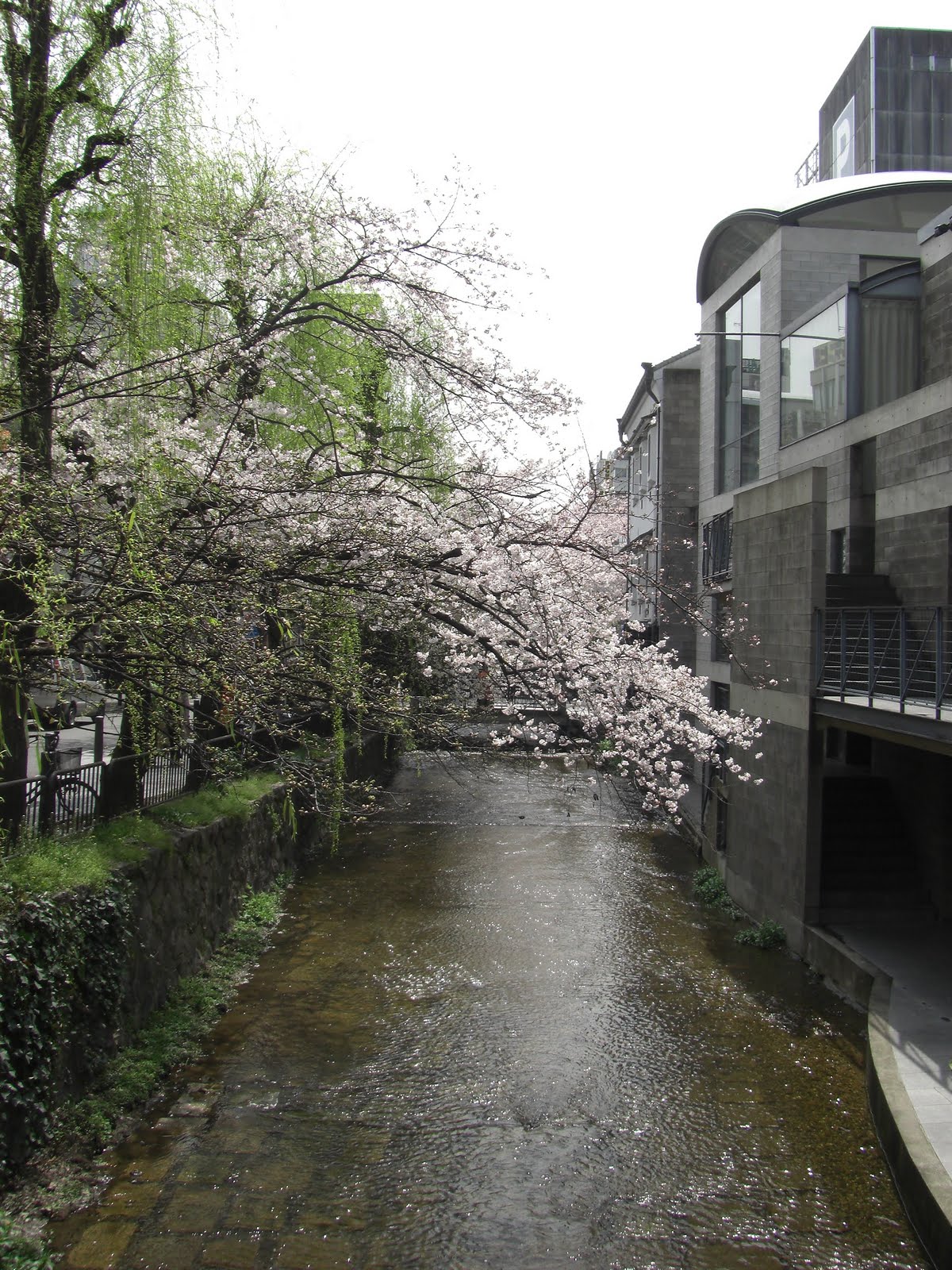
And yet, during they day, it's lovely. And really, at night, it's only shady in atmosphere, and not truly unsafe; I walked through many a night, and return to you all unmolested. Because, after all, say what you will about Japan, but it is pretty damn safe, a fact for which I am eternally grateful.


See? They're just like the sakura everywhere else in Kyoto. Pretty, pink, and surrounded by tourists.


I also thought the river/creek/stream/whatever added a nice aesthetic touch. What can I say, we desert folk love us some water.

And speaking of tourists...


I do apologize if I captured you or anyone you know in this picture, and assure you that it was not intentional. Rather, during 花見 season in Kyoto... it's something of a miracle if you get through the day without having someone in your pictures you didn't exactly invite into them. I wanted a shot down the stream, gosh darnit, and I was going to get one, obscured by tourists or no.

Well now, there's a thought my pointless picture post (I love unintentional alliteration, don't you?) inspires... 花見 season was certainly a validation for me, especially seeing as how I lived in Kyoto. You see, that time of year, Kyoto's population nearly doubles (I may be employing hyperbole, but still) with sheer tourist inflation. So, for almost the entire month of April, I was actually more "local" than a good percentage of the people giving me funny looks. As Melon would say, put THAT in your pipe and smoke it!

Although at the same time, gaijin tourist also began to come in droves, possibly making actual locals have far more reason to think I was just another English-speaking gomer blundering through some world-travels... Oh well. I suppose you can't have everything.

This is Edo, signing off whilst wondering if anyone really likes tourists....